 Liquid error (sections/image-banner line 171): invalid url input
While alternative laser technologies, such as UV Galvo, CO2 Galvo, and Blue Diode, each have specific industrial niches, evaluating the specific architecture of the VertiGo (a vertical system dedicated entirely to cylindrical objects on a bottom rotary platform) reveals why a 38W RF CO2 gantry-style setup is the clear choice.
It provides the optimal balance of production speed, optical consistency, machine capacity, safety, and a lower total cost of ownership for the custom drinkware market.

Here is a detailed breakdown of why an RF CO2 gantry laser is the superior engine for this specific machine architecture compared to all other major laser technologies.
1. The Glass Debate: Flawless vs. Commercial Standard vs. Incompatible
The ability to process glass drinkware efficiently is a primary requirement for a dedicated rotary machine. Each technology handles this material completely differently.
a. UV Galvo
It is unmatched for glass. UV operates via photolytic ablation (a "cold mark"), leaving a silky-smooth, premium frosted finish with essentially zero risk of the glass cracking due to thermal stress.
b. CO2 Gantry (The Choice)
CO2 is the industry standard. It achieves its mark through thermal shock, creating the classic, highly visible frosted look that consumers expect on commercial pint glasses and flutes.
While it has a slightly textured feel compared to UV, the results are highly commercial, easily repeatable, and perfectly suited for the vast majority of the market.
c. Diode Laser (450nm)
Blue diode lasers are effectively incompatible with production glass. Because visible blue light passes completely through clear objects, a diode laser cannot engrave bare glass.
The only way to mark glass with a diode is to apply messy marking sprays or paint the glass black before engraving, and then wash it off afterward. This adds massive labor costs and bottlenecks production.

2. Powder-Coated Tumblers: The Spot Size Bottleneck
For the massive market of powder-coated drinkware (Stanleys, Yetis, etc.), production speed and detail clarity are dictated by the laser's spot size.
a. UV Galvo (Too Tiny)
A UV laser has a microscopic spot size. While incredible for micro-engraving, it is a massive liability for tumblers. Filling in a solid, 3-inch wide company logo with a UV laser is like trying to fill in a coloring book using a sewing needle.
The laser must run incredibly dense, overlapping hatch lines to achieve a solid fill, which severely bottlenecks cycle times and makes high-volume production agonizingly slow.
b. CO2 Galvo (Too Muddy)
A CO2 galvo system is incredibly fast at moving its mirrors, but because of how its optics interact with the long CO2 wavelength, the focused spot size is massive (often 0.2mm to 0.5mm).
While it strips powder coat quickly, fine text and intricate logo details become muddy, over-burned, and lose all crispness.
c. CO2 Gantry (The Sweet Spot)
An RF CO2 gantry beam provides the perfect middle ground. Its spot size (roughly 0.05mm to 0.1mm) is thick enough to vaporize large areas of powder coat rapidly, but fine enough to maintain incredibly crisp edges on small text and detailed logos.

3. Diode Limitations: Weight Penalties and Color Blindness
While diode lasers offer a low-cost entry point into laser engraving, they suffer from severe physical and wavelength-specific limitations that make them unsuitable for a premium production machine like the VertiGo.
First, heavy multi-diode laser modules carry significant physical mass. When moving a heavy module up and down a vertical gantry, speeds must be kept relatively low to avoid mechanical wobble and vibration artifacts in the engraving.
Second, the 450nm blue light wavelength is highly dependent on material color. While a diode removes black or dark powder coat reasonably well, white or light-colored coatings naturally reflect the blue light.
Engraving a white tumbler requires running the diode at maximum power at an absolute snail's pace, often ruining production viability entirely.
CO2 lasers operate in the far-infrared spectrum, meaning they vaporize white, black, and colored powder coats with equal efficiency.

4. Engraving Length: The F-Theta Bottleneck
A vertical machine should be able to engrave the entire height of a tall tumbler or wine bottle. This is where the optical design makes or breaks the machine.
a. UV/CO2 Galvo
Because both UV Galvo and CO2 Galvo systems rely on stationary F-Theta lenses, the maximum vertical length of an engraving is strictly limited by the optical field of that lens (e.g., 70mm or 110mm).
If a design needs to run the full height of a tall 30oz tumbler, a galvo system physically cannot reach it without a complex, multi-step vertical indexing process that risks leaving visible seam lines.
b. CO2 Gantry
With a side-mounted CO2 Gantry setup, the vertical travel is dictated by a physical axis. The laser head seamlessly travels the entire vertical length of virtually any cup or bottle on the rotary, allowing for massive, full-length designs without being boxed in by a lens's fixed field of view.

5. Optical Consistency vs. Edge Distortion
Tying directly into the F-Theta lens limitation is the issue of beam quality. Galvo systems (both UV and CO2) have to deflect their beams at steep angles to reach the top and bottom edges of their engraving fields.
As the beam passes through the outer edges of the F-Theta lens, it suffers from distortion (elongation) and a noticeable drop in power. Engravings might look perfect in the center, but lose depth and crispness near the edges.
In a CO2 Gantry system, the beam always fires dead-center and perfectly perpendicular through the focusing lens. The laser delivers 100% consistent power and a perfectly circular spot size from the top rim of the tumbler all the way down to the base.
6. Working Distance, Footprint, and Lens Debris
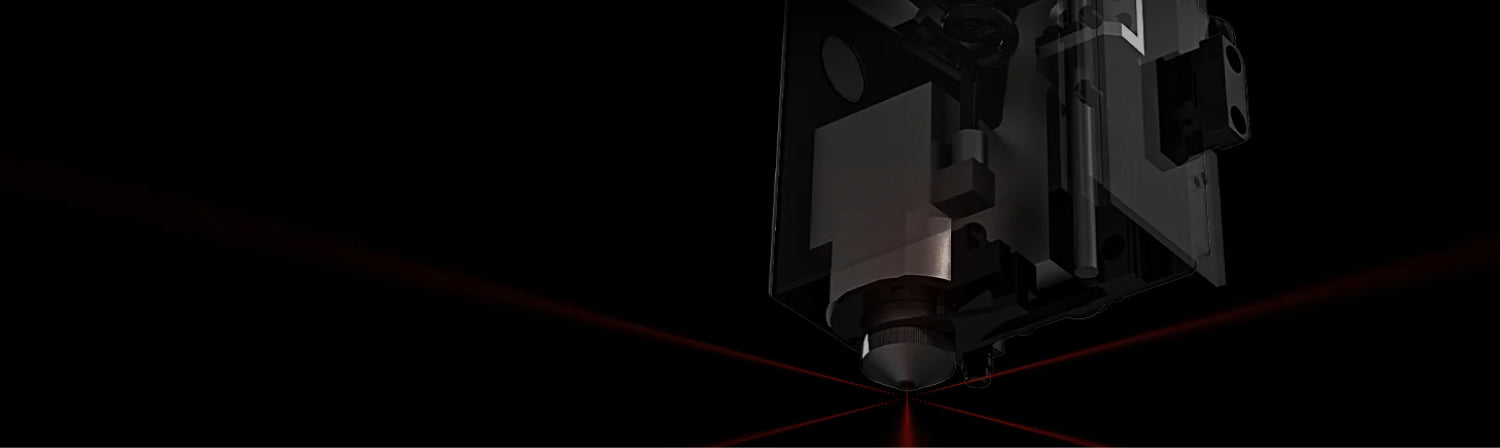
The optics dictate the physical footprint and capacity of the machine. A compact CO2 Gantry head typically requires a working distance of only about 50mm from the object.
a. Focal Distance & Machine Design Constraints
Galvo systems (both UV and CO2) require a huge focal distance to achieve their sweep. Even a small 70x70mm F-Theta lens requires roughly 100mm of clearance, and larger lenses require 160mm or more.
By forcing the laser assembly that far back from the rotary center, you eat up a massive amount of internal cavity space. This forces the machine to either be built impractically wide, or it severely restricts the maximum diameter of the objects the VertiGo can accept, entirely locking out highly profitable, wide items like dog bowls or ice buckets.

b. Optical Exposure & Maintenance Challenges
Furthermore, in a vertical layout, the large F-Theta lenses required by galvo systems sit on their side, directly facing the engraving area. This turns a massive, expensive piece of optics into a magnet for powder coat dust.
If not meticulously cleaned, debris heats up and permanently destroys the lens coating.
c. CO2 Gantry Advantage
Conversely, a CO2 Gantry setup houses a small focal lens behind an opening of only about 20mm.
This narrow aperture naturally shields the lens from debris. It is easy to wipe down, and a replacement CO2 gantry lens is a cheap consumable.
7. Safety and Enclosure Complexity
Operator safety is drastically different depending on the wavelength of light being generated.
The wavelengths produced by UV (355nm) and Diode (450nm) lasers are incredibly hazardous to the human eye. A stray reflection off a curved, shiny tumbler can cause instant, permanent retinal damage. Safely enclosing these lasers requires highly specialized, expensive optical viewing windows, driving up the cost of the machine frame.
CO2 lasers (10,600nm) operate in the far-infrared spectrum, which is naturally absorbed by standard glass and clear acrylic. This makes a CO2 machine significantly safer and less expensive to fully enclose, as standard protective acrylic viewing windows easily and effectively block the beam from escaping the chassis.

8. FAQs
1. Why is a 38W RF CO2 gantry laser the best choice for VertiGo?
It delivers the best balance of speed, consistency, capacity, safety, and cost for high-volume drinkware production.
2. Can UV lasers engrave glass better than CO2?
Yes, UV lasers create smoother, premium finishes, but CO2 provides the industry-standard, cost-effective result for commercial production.
3. Why are diode lasers not suitable for glass engraving?
Because blue diode lasers pass through clear glass, requiring extra steps like paint or sprays, which slows production.
4. What makes CO2 gantry better for powder-coated tumblers?
It offers the ideal spot size, fast enough for large fills and precise enough for detailed logos and text.
5. Why are UV lasers too slow for tumbler production?
Their tiny spot size requires dense passes, making large-area engraving extremely time-consuming.
6. Do CO2 galvo lasers reduce engraving quality?
Yes, their larger spot size can cause blurry edges and loss of fine detail.
7. What are the main limitations of diode lasers in production?
They are slower, struggle with light-colored coatings, and can cause vibration due to heavy laser modules.
8. Can galvo lasers engrave full-length tumblers?
Not easily. They are limited by lens field size and require multi-step indexing for tall designs.
9. Why is a gantry system better for full-wrap engraving?
It allows continuous vertical movement, enabling seamless full-length designs without alignment issues.
10. Do galvo systems have consistency issues?
Yes, engraving quality can drop near edges due to beam distortion and power loss.
11. How does a CO2 gantry ensure consistent engraving quality?
The beam stays perpendicular and centered, delivering uniform power and sharp results across the entire surface.
12. Why do galvo systems require larger machine footprints?
Their long focal distance pushes components back, reducing internal space and limiting object size.
13. Are CO2 gantry systems easier to maintain?
Yes, they use smaller, protected lenses that are easier and cheaper to clean or replace.
14. Which laser type is safer for enclosed machines?
CO2 lasers are safer because their wavelength is easily blocked by standard acrylic, unlike UV or diode lasers.
15. What is the biggest advantage of CO2 gantry for drinkware businesses?
It supports high-volume production of various drinkware sizes with consistent quality and low operating cost.
The Verdict
While Galvos offer incredible speed for small, flat marks, and Diodes offer cheap entry points for hobbyists, they introduce severe physical, optical, and safety bottlenecks into a vertical rotary workflow.
The 38W RF CO2 Gantry is the ultimate production engine for the VertiGo. It perfectly supports churning out high volumes of powder-coated tumblers of any color, allows for infinite vertical wrap capabilities with consistent power from top to bottom, accepts massive object diameters, and provides a robust, safe, low-maintenance optical path