 Liquid error (sections/image-banner line 171): invalid url input
When researching laser machines, one of the biggest questions people ask is: How long do laser engravers last?
Whether you’re a hobbyist planning your first project or a business owner investing in production equipment, understanding the lifespan, durability, and maintenance needs of different laser types is essential. The truth is that not all laser engravers are built the same and depending on the type of laser tube, the difference in lifespan can range from a few hundred hours to over 50,000 hours.
Key Takeaway
In this guide, we’ll break down the real-world lifespan of diode lasers, glass CO₂ lasers, and RF metal tube lasers, explain the factors that affect longevity, introduce how OneLaser machines are engineered for long-lasting performance, and share expert tips on maximizing the life of your laser engraver.
If you're searching for information on how long do laser engravers last, how long does a laser engraver last, or the lifespan of a laser engraver, this guide covers everything you need to know with clear examples and practical insights.
1. How Long Do Laser Engravers Last?
Here are the typical lifespans for the three major laser types:
|
Laser Type |
Average Lifespan |
Usage Level |
|
Diode Laser |
3,000 – 10,000 hours |
Hobby use, light engraving |
|
Glass CO₂ Tube |
1,500 – 3,000 hours |
Hobby to small business |
|
RF Metal CO₂ Tube |
20,000 – 50,000 hours |
Professional + industrial |
As you can see, the lifespan of a laser engraver varies dramatically depending on the laser source. The tube not the frame is what determines the true lifetime of your machine.
Let’s break down each type in detail.
2. Lifespan of Diode Laser Engravers
Diode lasers are popular among beginners due to their affordability, small size, and ease of use. But when it comes to lifespan and engraving performance, they have limitations you should understand.
✔ How Long Do Diode Laser Engravers Last?
Most diode lasers last 3,000 to 10,000 hours. This is the longest lifespan among low-cost laser options, but diode lasers are limited because:
- They cannot cut clear acrylic
- They struggle with thick wood
- They engrave slower than CO₂ or RF lasers
- They are sensitive to overheating
- They lose power over time
A diode machine may last several years with light hobby use, but it is not designed for high-volume production or professional results.
✔ Diode Laser Pros
- Inexpensive
- Long lifespan relative to cost
- Good for basic engraving
- Easy to maintain
✔ Diode Laser Cons
- Poor cutting performance
- Cannot cut transparent materials
- Very slow compared to CO₂ and RF
- Beam alignment is less stable
- Not suitable for business use
If you only plan to engrave lightly or test the hobby, a diode laser may be fine but it will not scale with your needs.
3. Lifespan of CO₂ Glass Tube Laser Engravers
Glass CO₂ tubes are the most common in hobbyist and mid-range laser machines. They deliver stronger cutting power and faster speeds than diode lasers, but their lifespan is significantly shorter.
✔ How Long Do CO₂ Glass Tube Laser Engravers Last?
A typical CO₂ glass laser tube lasts 1,500 to 3,000 hours, depending on:
- power settings
- cooling system quality
- humidity and temperature
- tube manufacturing quality
- operating habits
This means that if you run a small business and engrave frequently, you may need to replace a glass tube every 6–12 months.
Glass tubes also degrade over time even when not in use due to gas leakage and chemical instability.

✔ CO₂ Glass Tube Pros
- Affordable upfront cost
- Strong cutting power
- Suitable for beginners
- Handles many materials
✔ CO₂ Glass Tube Cons
- Short lifespan
- Requires water cooling
- Fragile and easily damaged
- Beam quality degrades over time
- Not ideal for high-precision engraving
Glass tubes remain popular for budget buyers but long-term, their short lifespan adds up.
4. Lifespan of RF Metal CO₂ Laser Engravers (The Longest-Lasting Option)
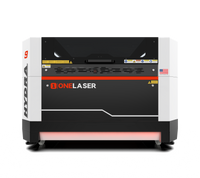
RF (radio-frequency excited) laser tubes are the gold standard in the engraving industry. These are the tubes used in premium machines like the OneLaser XRF and the OneLaser Hydra Dual-Laser Systems.
✔ How Long Do RF CO₂ Laser Engravers Last?
RF tubes typically last 20,000 to 50,000 hours, making them the longest-lasting laser technology available.
For many businesses, this means:
- No tube replacement for 5–8+ years
- Stable performance even under heavy workloads
- Long-term consistency and reliability
- Lower overall operating cost
Because RF tubes are housed in metal instead of glass, they are extremely durable, vibration-resistant, and practically maintenance-free.

✔ RF Laser Tube Pros
- Best beam quality
- Industry-leading lifespan
- Ultra-fine engraving (0.05–0.07 mm)
- Air-cooled no chiller needed
- Fast response time and high-speed engraving
- Consistent output over the years
- High ROI for businesses
✔ RF Laser Tube Cons
- Higher upfront cost
- Overkill for very casual hobbyists
If you rely on a laser for your business, RF is unquestionably the best long-term investment.
5. Diode vs. CO₂ vs. RF Which Laser Lasts the Longest?
Here’s the direct comparison:
|
Feature |
Diode |
CO₂ Glass Tube |
RF Metal Tube |
|
Lifespan |
3,000–10,000 hrs |
1,500–3,000 hrs |
20,000–50,000 hrs |
|
Beam Quality |
Weak |
Moderate |
Excellent (smallest spot) |
|
Cooling |
Air |
Water |
Air |
|
Replacement Cost |
Low |
Moderate |
Higher |
|
Engraving Detail |
Low |
Medium |
High precision |
|
Business Use |
Not ideal |
Good |
Best |
|
Reliability |
Medium |
Low |
Very high |
If long lifespan and quality matter, RF metal tubes win by a massive margin.
6. How Long Do OneLaser Machines Last?
OneLaser machines are engineered to maximize lifespan, stability, and long-term performance. Here’s why they’re different:
✔ OneLaser X Series (XRF & XT)
XRF (38W RF Metal Tube)
- Lifespan: up to 30,000 hours
- Ultra-fine engraving (0.07 mm spot)
- 3D photorealistic capability up to 2000 DPI
- Air-cooled RF system
- No beam alignment required
- Fully enclosed for dust-free operation
- Intelligent noise reduction under 65dB
XT (55W Glass CO₂ Tube)
- Strong cutting performance
- Affordable entry solution
- Ideal for growing hobbyists
Explore the OneLaser X Series!

✔ OneLaser Hydra Series (7, 9, 13, 16 Models)
Hydra machines are industrial-grade dual-laser systems combining:
- Glass CO₂ tube for cutting
- RF metal tube for engraving
Built for 24/7 production environments, they feature:
- Up to 30,000-hour RF tube lifespan
- Massive work areas (up to 62.99" x 39.37")
- FumeGuard™ industrial filtration
- 3G acceleration for unmatched speed
- Water-cooled glass tubes for heavy cuts
- Air-cooled RF tubes for precision engraving
- Sealed enclosure for safer operation
- Advanced airflow and dust management
Whether you're a beginner or a professional manufacturer, OneLaser provides machines built for long-term reliability.

7. What Affects the Lifespan of a Laser Engraver?
Even if your machine has a high-quality laser tube, several factors influence its true lifespan.
7.1 Operating Power Levels
Running at maximum power all the time drastically shortens tube life.
A good rule is:
- RF tubes: operate at 60–90%
- Glass tubes: operate at 50–70%
7.2 Cooling Quality
This matters most for glass tubes:
- Bad coolant
- Weak water flow
- High temperatures
…can kill a CO₂ tube in days.
RF tubes are more forgiving since most are air-cooled.
7.3 Environmental Conditions
Heat, humidity, dust, and vibration shorten lifespan.
A laser engraver must be stored in a stable, clean space.
7.4 Usage Frequency
Heavy shops will burn through glass tubes much faster than hobby users.
RF tubes, however, are designed for continuous duty cycles.
7.5 Optical Cleanliness
Dirty mirrors or lenses cause beam scatter, forcing the tube to work harder, shortening its lifespan.
7.6 Build Quality of the Machine
Cheap machines:
- vibrate
- misalign
- overheat
- lack safety interlocks
High-end machines (like OneLaser) use:
- rigid metal frames
- advanced cooling
- precise linear motion
- professional-grade components
All of which extend tube lifespan dramatically.
8. How to Extend the Lifespan of Your Laser Engraver
Here are the best ways to make any laser diode, CO₂, or RF last longer.
8.1 Keep the Optics Clean
Dust, resin, and smoke buildup can dramatically shorten tube life.
Clean:
- lens
- mirrors
- windows
…weekly, or more often for heavy users.

8.2 Maintain Optimal Cooling
For glass CO₂ tubes:
- Use distilled water
- Keep temperature 15–25°C
- Use a proper water chiller
- Avoid air bubbles in the coolant line
For RF tubes:
- Keep airflow unobstructed
- Clean vents
8.3 Avoid Running at Maximum Power
Max power stresses the laser tube. Use the lowest power that achieves the desired result.
8.4 Use High-Quality Materials
Cheap materials can release corrosive fumes, damaging:
- mirrors
- fans
- filters
- tubes
8.5 Keep the Machine Clean and Dust-Free
Remove:
- soot
- ash
- resin
- debris
These can ignite or reduce airflow.
8.6 Replace Filters on Time
If smoke cannot escape efficiently, heat rises and shortens tube life.
8.7 Perform Regular Mechanical Maintenance
Check:
- belts
- rails
- bearings
- gantry alignment
A smooth-running machine reduces strain on the laser.
8.8 Follow Manufacturer Guidelines
Companies like OneLaser provide safety, maintenance, and calibration guides to keep your machine running at peak performance.
9. Maintenance Checklist for Maximizing Laser Lifespan
Here is a simple maintenance checklist you can use weekly or monthly.
|
Maintenance Frequency |
Tasks |
|
Daily Maintenance |
• Clean lens lightly after heavy jobs • Empty honeycomb debris • Check airflow • Inspect water chiller (CO₂ only) • Verify no burning smell or unusual noise |
|
Weekly Maintenance |
• Clean mirrors • Wipe down rails and apply lubricant • Vacuum out debris • Check belt tension |
|
Monthly Maintenance |
• Replace air filters• Flush water chiller (if needed)• Inspect wiring• Check tube output consistency |
|
Annual Maintenance |
• Replace coolant • Perform deep cleaning and alignment check • Inspect fans, motors, and rails • Replace worn belts |
Why OneLaser Machines Are Built to Last Longer
OneLaser engravers including the X Series and Hydra Series are designed with durability in mind:
- Industrial-grade frames
- RF tube lifespan up to 30,000 hours
- Intelligent cooling
- Advanced DSP motion control
- Enclosed, dust-resistant architecture
- FumeGuard™ safety
- Precision optics with minimal drift
- High-speed engraving without wear
Whether you're a beginner or running a full-time engraving business, OneLaser systems maximize lifespan, quality, productivity, and long-term ROI.